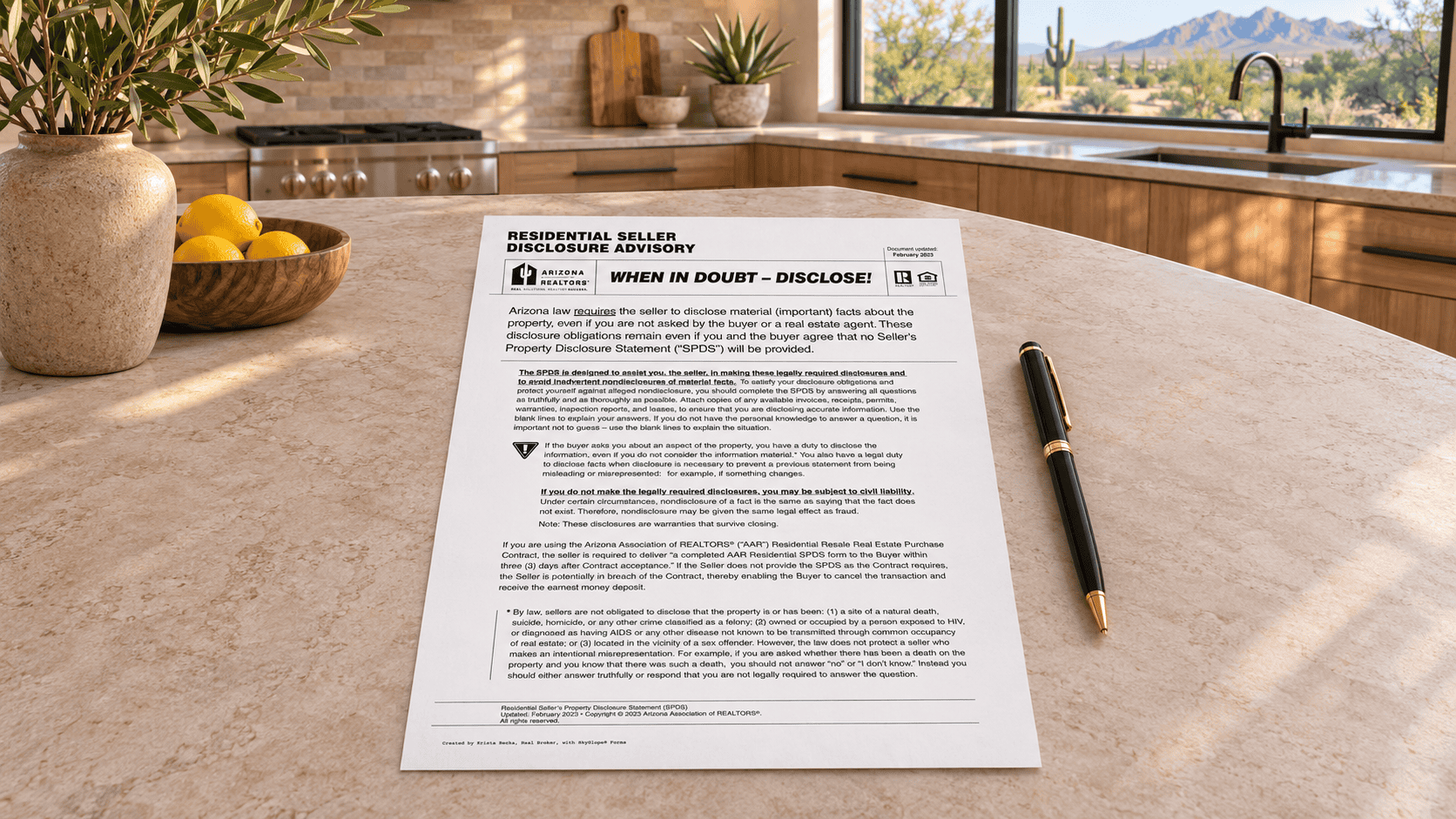
What do you have to disclose when selling a home in Scottsdale, Arizona?
You have to disclose every material fact you know about the property, meaning anything that could affect a buyer’s decision or the home’s value. In practice, that’s done on the Arizona Association of REALTORS® Seller’s Property Disclosure Statement (SPDS), which the standard purchase contract expects you to deliver within 3 days after contract acceptance. The duty applies even in an As-Is sale, and fixing a problem doesn’t erase it. Past repairs, unpermitted work, and known defects belong on the form, with explanations.
By Krista Becka, REALTOR® and Broker Associate | November 4, 2026
Most sellers I work with don’t get into trouble because they hid something. They get into trouble because they answered “no” from memory, or assumed a repair that’s been fixed doesn’t count. In a market where Scottsdale had roughly four months of supply in October 2026, buyers have options and their inspectors are thorough.
What trips up sellers and how to fill it out well.
What the SPDS is and when it’s due
The SPDS is a roughly 10-page form from the Arizona Association of REALTORS®. It walks through ownership and property details, building and safety items, utilities, sewer or wastewater, environmental conditions, and anything else a buyer would want to know.
Under the standard Arizona purchase contract, the seller delivers the completed SPDS 3 days after contract acceptance. The contract language and deadlines can be modified, so check the version you actually signed. A buyer reads it, schedules inspections, and decides whether to move forward, ask for repairs, or cancel within their due diligence window.
Two points matter more than the form itself:
- The duty exists whether or not the form is used. Arizona’s disclosure obligation attaches to material facts you know, so it doesn’t disappear if the parties skip the SPDS.
- “As-is” doesn’t mean “undisclosed.” As-is changes who handles repairs. It doesn’t change what you have to tell the buyer.
How the SPDS fits with inspections
Buyers don’t need to read the SPDS in isolation. They can hand it to their inspector, then compare what you wrote against what the inspection finds. When the two match, the conversation stays about price and repairs. When the inspection turns up something the form didn’t mention, the conversation can turn to trust, and that can be expensive.
That’s why I often recommend a pre-listing inspection on larger or older homes. You see the same list the buyer’s inspector will see, you decide what to fix before photos, and you disclose what’s left in your own words. It also gives you documentation to attach to the SPDS instead of leaving the buyer to wonder.
If you’re on the buying side, read the SPDS line by line before your inspection, and ask your agent about every “yes” and every “unknown.” Those are the places to point your inspector.
Filling it out the right way
Where Scottsdale sellers get tripped up
At $1 million and above, homes tend to have more systems, more additions, and more history. That’s where the gaps show up:
- Pool, spa, and outdoor kitchen equipment. Pumps, heaters, automation, and past leaks. If you’ve had a repair, say so.
- Additions and conversions. Casitas, enclosed patios, garage conversions, and remodels. If you don’t know whether the work was permitted, the honest answer is “unknown,” and you shouldn’t check “permitted.”
- Roof history. Repairs, leaks, tile underlayment issues, and flat-roof sections on contemporary builds.
- Solar. Owned versus leased or financed systems changes what a buyer assumes and what their lender needs to see.
- HVAC and plumbing. Multiple units on larger homes, older supply lines, and past repairs.
- Drainage, grading, and flood-related history. Even small incidents count.
- Sewer, septic, or well. Common on larger-lot properties outside the dense parts of the city.
- HOA items. Assessments, pending special assessments, architectural restrictions, and rental limits.
- Pest history. Termite treatments and any known damage.
A good rule: if a past buyer, inspector, insurance carrier, or contractor ever mentioned it, it probably belongs in the explanation field.
A step-by-step approach
- Gather documents first. Permits, repair invoices, warranties, pool service records, roof reports, and prior inspection reports. Attach them where they fit.
- Answer from knowledge, not memory. Walk the property with the form in hand.
- Explain every “yes.” A short, factual note, with a date and what was done, builds credibility.
- Don’t speculate. If you don’t know, say you don’t know. Don’t guess in either direction.
- Disclose repaired issues. A fixed problem with a receipt reads very differently than one a buyer discovers later.
- Update it if something changes. If a new issue appears after you submit the form, tell your agent so the buyer is told promptly.
- Have your agent review it before it goes out. Not to soften it, but to make sure it’s complete and consistent with your listing.
I’d rather spend an hour with a seller before we list than spend days after contract sorting out a surprise. The pre-listing conversation is where we decide what to inspect, what to repair, and what to disclose.
What happens if you leave something out
A material fact omitted from the SPDS can give a buyer grounds to cancel during the contract period, and potentially to pursue a claim after closing. Intentional concealment can be treated as fraud. Even without bad intent, a buyer who finds something your form should have mentioned is a buyer who negotiates harder, or leaves.
None of this is legal advice. If you’re in a situation with a known significant defect, a dispute, or an estate or trust sale, talk to your Arizona real estate attorney alongside your agent. Every situation is different, and the answer for your property depends on what you actually know about it.
Frequently Asked Questions
Where can I find a copy of the Arizona Association of REALTORS® Seller’s Property Disclosure Statement (SPDS)?
You can download a copy at Arizona Seller’s Property Disclosure Statement.
Is the SPDS required by law in Arizona?
The form itself comes from the Arizona Association of REALTORS® and is built into the standard purchase contract, but the underlying duty is broader. Arizona expects sellers to disclose known material facts, and that obligation exists even if the SPDS is waived or the sale is as-is.
Do I have to disclose repairs I’ve already fixed?
Yes. Past repairs, especially for roofs, plumbing, pools, and water intrusion, are generally part of the history a buyer would want to know. Include what happened, when, who did the work, and attach the invoice if you have one.
What if I don’t know whether work was permitted?
Say that you don’t know. Don’t mark it permitted without proof. Your agent can help you check city records and decide whether to address it before listing.
Can I sell as-is and skip the disclosure?
No. As-is means you’re not agreeing to make repairs, but you still have to be truthful about what you know. The disclosure duty stays in place.
If you’re getting ready to list and want a second set of eyes on your SPDS before it goes to a buyer, schedule a consultation at kristabecka.com/contact — I’m happy to walk through it with you.
About Krista Becka Scottsdale Realtor Krista Becka helps buyers and sellers across Scottsdale, Arcadia, Paradise Valley, and Greater Phoenix make confident moves. For nearly two decades she’s guided move-up buyers and sellers, relocation clients, and investors, protecting equity and helping clients avoid costly mistakes. A Broker Associate with Compass, Certified Luxury Home Specialist, and Certified Negotiation Expert, Krista blends data-driven pricing with hyperlocal insight and concierge-level service. Connect with Krista at kristabecka.com
Leave a Reply